Zero Trust Architecture & Layer 7 DDoS Mitigation
A homelab security architecture designed to isolate a self-hosted Splunk instance behind Cloudflare and validate Layer 7 DDoS mitigation through WAF rate limiting and SIEM telemetry analysis.
Project Overview
I built this project to protect a self-hosted Splunk Enterprise instance running on an Ubuntu server from direct exposure to the public internet.
The architecture uses an outbound-only Cloudflare Tunnel to isolate the origin, Cloudflare Access to enforce identity-based access control, and a WAF rate-limiting policy to mitigate high-volume Layer 7 HTTP traffic at the edge.
The primary objective was to simulate a Layer 7 DDoS attack against the public application endpoint and verify the complete security pipeline: the attack reaching Cloudflare, the WAF detecting and blocking the traffic, Cloudflare recording the resulting security events, and Splunk confirming what traffic actually reached the origin.
Architecture & Tech Stack
Origin: Ubuntu server running Splunk Enterprise
Edge: Cloudflare
Secure Access: Cloudflare Tunnel & Cloudflare Access
DDoS Mitigation: Cloudflare WAF Rate Limiting
SIEM: Splunk Enterprise
Telemetry: /var/log/auth.log and /var/log/cloudflared.log
Implementation Phases
Phase 1:
Origin Isolation with Cloudflare Tunnel
I connected the Ubuntu server to Cloudflare using
cloudflared. The tunnel establishes an outbound
connection from the origin to Cloudflare, allowing the application
to be published without exposing a direct inbound port on the
Ubuntu server.
This established the foundation for the security architecture: internet traffic would first reach Cloudflare rather than directly reaching the underlying Splunk host.
Phase 2:
Zero Trust Access Control
I configured Cloudflare Access to protect the public application
endpoint. Unauthenticated requests were intercepted at the edge
and redirected to the configured identity authentication flow.
This placed identity verification in front of the application, allowing the subsequent attack simulation to test the interaction between Zero Trust access controls and the WAF.
Phase 3:
Layer 7 DDoS Attack Simulation
I then simulated a Layer 7 DDoS attack against the public
application endpoint by generating a rapid sequence of HTTP
requests. The purpose was to deliberately create a high-volume
request condition and determine whether the Cloudflare edge
controls would identify and mitigate the traffic before it
reached the origin.
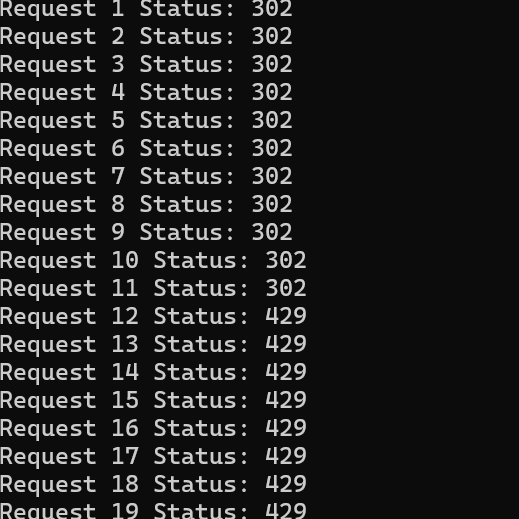
The initial requests returned HTTP 302 responses as
Cloudflare Access intercepted the unauthenticated traffic.
As the request volume continued, the configured WAF rate-limiting
threshold was reached and subsequent requests returned
HTTP 429 Too Many Requests.
This demonstrated the intended attack path: the simulated malicious traffic reached the Cloudflare edge, triggered the configured rate-limiting control, and was rejected before continuing toward the application.
Phase 4:
Cloudflare Edge Mitigation & Security Events
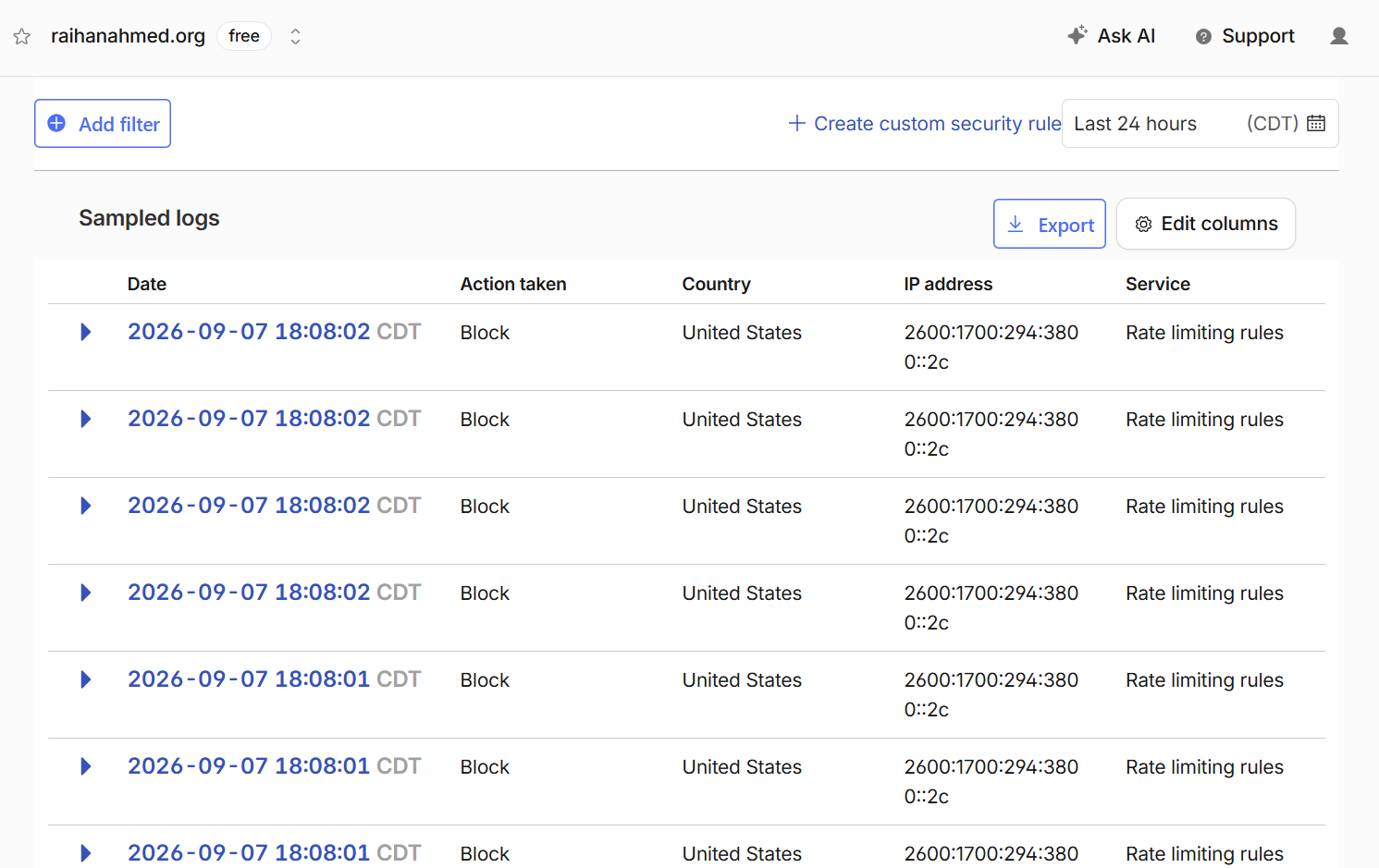
After running the attack simulation, I reviewed Cloudflare
Security Events to verify that the WAF had identified and
blocked the request traffic.
The Security Events dashboard recorded blocked requests associated with the configured rate-limiting policy. This provided independent evidence from the edge that the WAF mitigation was actively responding to the simulated attack traffic.
Phase 5:
Splunk Origin Telemetry Verification
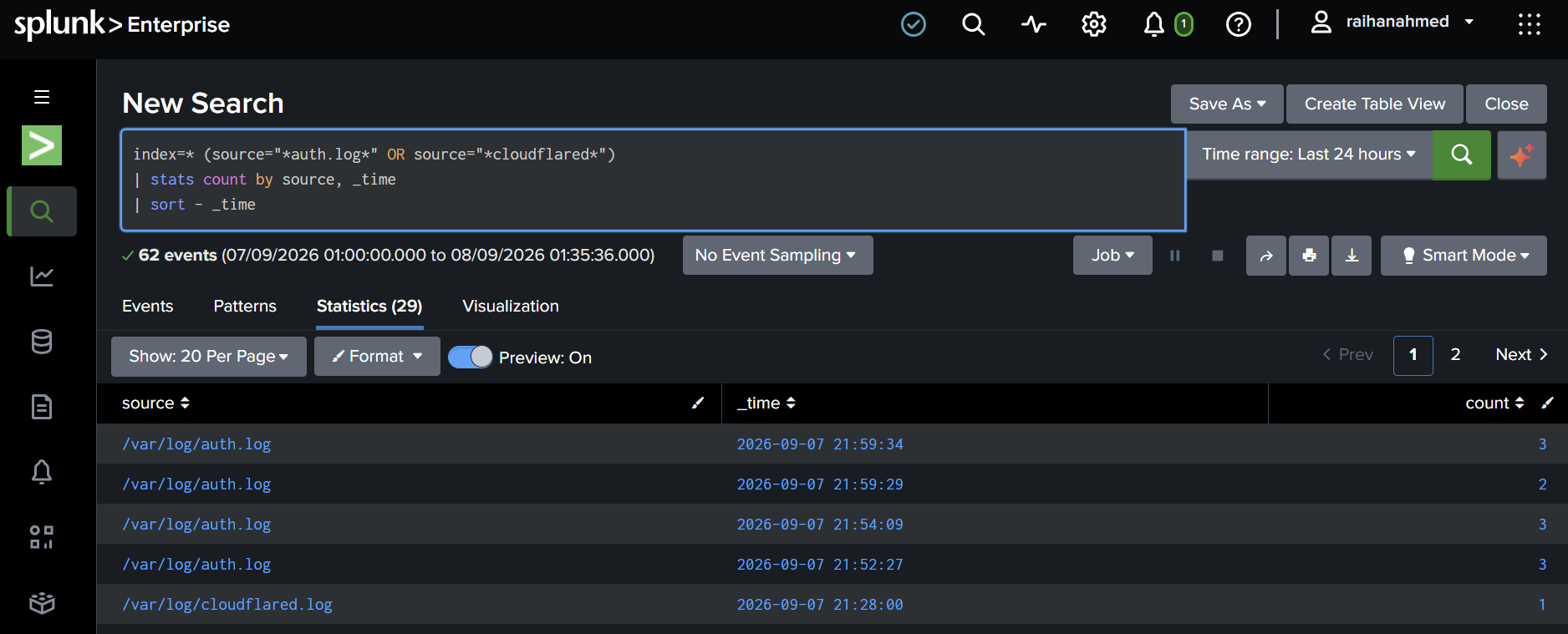
The final step was determining whether the attack traffic
actually reached the Ubuntu origin. I configured Splunk to
ingest host-level telemetry from
/var/log/auth.log and
/var/log/cloudflared.log.
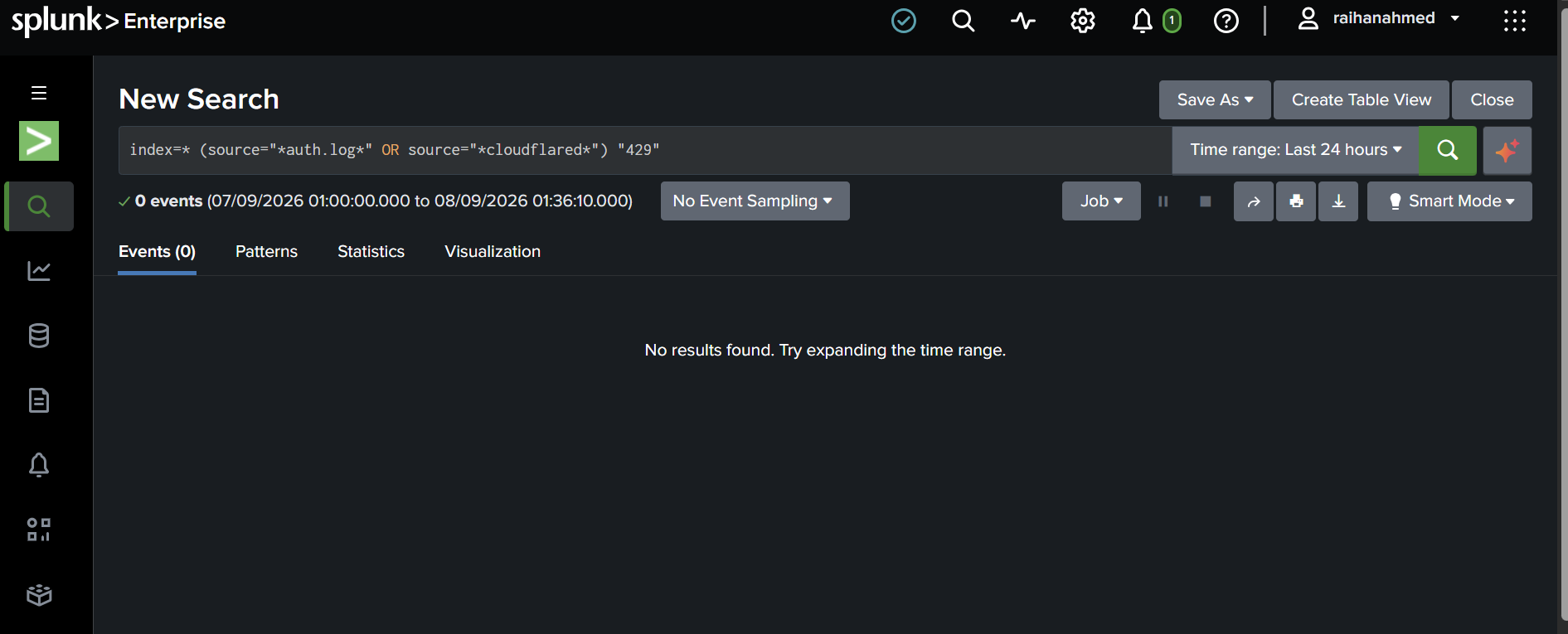
I then searched the ingested telemetry for
"429", matching the HTTP status generated during
the WAF mitigation test. The search returned zero matching
events, while Cloudflare Security Events showed the traffic
being blocked at the edge.
Comparing the two telemetry sources provided evidence that the
rate-limited attack traffic was handled by Cloudflare before
corresponding 429 events appeared in the
origin-side logs.
Security Relevance
This project demonstrates a layered approach to defending a self-hosted security infrastructure environment. Cloudflare Tunnel isolates the origin from direct inbound exposure, Cloudflare Access adds identity-based access control, and WAF rate limiting provides an edge control for high-volume application-layer traffic.
The DDoS simulation also demonstrates the value of correlating edge and host telemetry. Cloudflare provided visibility into the attack and mitigation activity, while Splunk was used to determine whether corresponding traffic appeared in the origin environment.
Layer 7 DDoS Traffic
       ↓
Cloudflare Edge
       ↓
Cloudflare Access
       ↓
WAF Rate Limiting
       ↓
Blocked / HTTP 429
       ↓
Cloudflare Security Events

Allowed Traffic
       ↓
Cloudflare Tunnel
       ↓
Ubuntu / Splunk
       ↓
Origin Telemetry Verification
This project was built as a hands-on security homelab to demonstrate Zero Trust architecture, Layer 7 DDoS mitigation, edge security monitoring, and SIEM-based verification using Cloudflare and Splunk.